Samstag, 26. Februar 2011

Cuben Fiber rain pants

I think rain pants are the least-used item in my pack. I still remember my first rain pants; a pair of rubber overalls that probably weighed in at a few pounds. I've had many pairs of rain pants since then. The last pair I purchased was a pair of o2 rainpants, weighing in at 126 grams (4.4 oz). That's pretty damn light, but I still don't feel good about carrying around an extra 1/4 pound of rain pants that I've only ever worn twice. So I recently ordered some cuben fiber and got to work.

The cuben fiber I'm working with is CT0.6K.08 and weighs 15g/sq. meter (0.5 oz). I initially bought it with the purpose of making stuff sacks, and had the idea for rain pants along the way. I dissected a pair of old EMS goretex rain pants that had long seen their glory days. I then laid the parts out on thick plastic and made a mock pair to try on. They fit well, so I was able to use the mock-up parts as a pattern.

I'm using cuben tape for all the seams, and some leftover elastic cord from my tent poles for the waist. The finished rain paints weigh in at a whopping 35.5 grams (1.25 oz)! I think I've achieved absolute minimum wieght on these. Here are some pictures:


Here's a close-up of the taped seams:


and they pack up small too...


Freitag, 25. Februar 2011

Adventures in Cuben

I've finally taken the plunge and ordered some cuben fiber. I've been curious about it for a while, and decided to get some for making stuff sacks out of. Well, here's my first stuff sack. It's for my tent, and weighs 8.9 grams (0.31 oz). The cuben fiber I'm working with is CT0.6K.08 and weighs 15g/sq. meter (0.5 oz). It's put together with cuben tape. There will be more cuben fiber projects for me in the future!

Montag, 21. Februar 2011

a really warm lightweight fleece jacket!

I've been searching for the perfect fleece jacket for a number of years. Most of the ones I've seen are just too plain heavy and have so many unnecessary features that really detract from the basic function I want. That's why I designed my own. It has a full length zipper, no pockets, and an extra tall collar that zips not quite to the top, leaving a little breathing spot for the nose. I left the bottom of the jacket pretty long, and it comes down about 2cm below the zipper. This gives me a good overlap between my layers.


The material I chose to use is 6 oz microfleece from Malden Mills. It's incredibly warm for it's weight, which comes in at 145 grams/sq. meter. The total weight of the jacket is 206 grams (7.26 oz)


I made a minimalist Primaloft Vest

I like wearing vests, but when made out of fleece they can aren't as light as they could be. I had the idea to make a minimalist vest out of something lighter, and decided on 2.5 oz primaloft sport synthetic insulation (60g/sq. meter) quilted to 1.3 oz quantum ripstop nylon (32g/sq. meter). I took a vest that has been one of my favorites for years (an old softshell fleece from Ragged Mountain) and based my design off of it. One feature I really like is that it is longer in the back, covering the typical gap that lets in cold air between the pants and shirt. It has a number of "Features", such as:

-no Pockets
-no collar (I hate having 3 or 4 collars all stacked on top of each other, competing for neck space!)
-ultra-light elastic edging, to keep it snug around my body and not let wind in

I'm very satisfied with the result. The final vest is really warm, and weighs a total of 87 grams (3.06 oz). A great addition to my lightweight kit for cold weather.

Here are a few pictures of the finished vest:


a view of the creative quilting on the back:


and one more of the front:

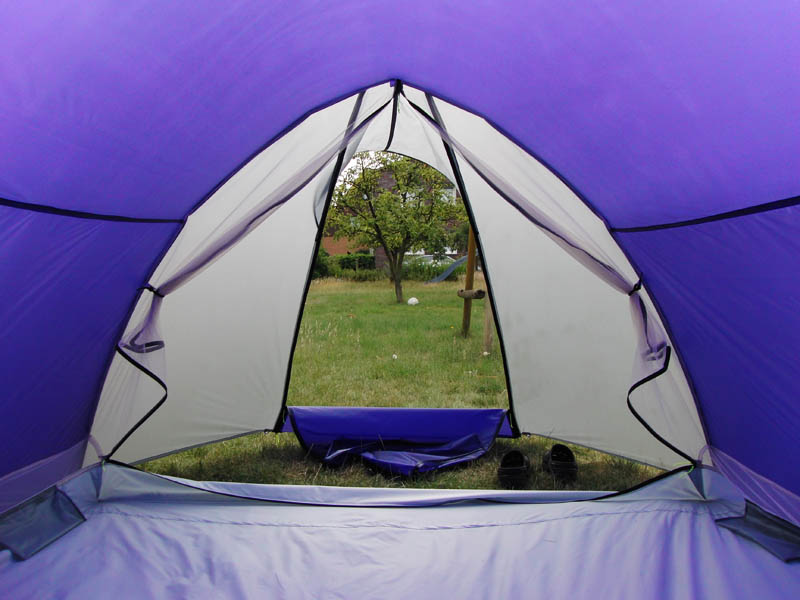
Self-made Tunnel Tent


This is a tunnel tent I made. The material is 1.1 oz silnylon for the shell, and 2.2 oz PU coated nylon for the floor. It’s a single walled design with a bathtub floor.

Dimensions in metric: the interior is194 cm wide, 330 cm long, 130 cm high, with 60 cm vestibule at the door. Total weight, 2182 grams.

Dimensions imperial: the interior is 6 feet 4.5 inches wide, 10 feet 10 inches long, 4 feet 3 inches high, with a 2 foot vestibule at the door. Total weight 4 pounds 8.9 oz

some pics:


The door can be opened to the top or the bottom.


Here's a view to the back:


This is a single-walled tent with a bathtub floor and netting attaching it to the shell. The shell is made of silnylon, the floor of PU coated nylon. The poles are lightweight aluminum.

Here are some pics of the tieouts:


 and one of the whole thing rolled up:


Sonntag, 30. Januar 2011

My path to lightweight backpacking

I started my backpacking days when I was 17. I was part of a volunteer program doing work in national parks, and the last week of the program was a 5 day backpacking trip in the White Mountains. Our group leader helped us with organizing our gear, and making sure we were carrying the right amount of weight based on our abilities. I was young and strong, and didn't mind carrying the 65 pounds sorted into my pack. I can't imagine shouldering that pack these days.

I started thinking about the items in my pack after that trip, and realized I could probably do without a few things. I was able to reduce it somewhat on my next trip, down to about 60 pounds. I still wasn't actually weighing any items, just trying to bring only necessary things. Some items were a necessary evil. It's amazing how heavy and useless a few sweat-soaked cotton t-shirts are.

My first venture into the lightweight world happened when I bought an MSR pocket rocket and titanium cooking pot. It was a good deal at EMS. Buy the stove, get the pot half off. Both items were the letest in technology at the time, and were ridiculously light, weighing a total wieght of 210 grams. This opened my eyes to the idea of weighing items in my pack, and finding, buying or making items that were lighter. I was able to slowly upgrade my setup, and a few years later I was only carrying around 40 pounds. My methods and system had become more streamlined, and I had discovered wonderful new advances in gear such as lightweight synthetic clothing and goretex rain gear.

making my own gear and rethinking the necessity of all items in my kit has pushed my baseweight down even further over time, largely due to endless amounts of information i've gained on the forum backpackinglight.com I'm down to 18 pounds baseweight for multiday trips.

This blog is dedicated to showing my homemade gear and the trips I take with it. Enjoy.